
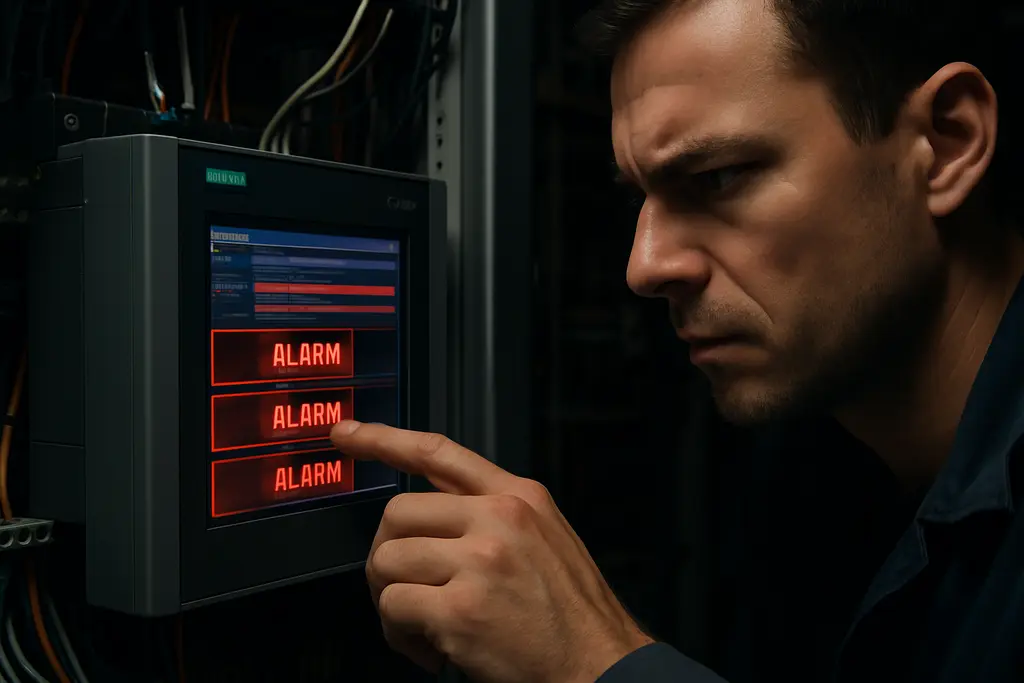
Siemens S7 PLCs became the subject of a new U.S. federal warning on August 19, 2026, after NSA, CISA, FBI, DOE, and EPA reported active threats against programmable logic controllers used in critical infrastructure. The agencies said threat actors are using AI-generated exploitation scripts in activity aimed at these controllers, according to the NSA release. The warning is significant because PLCs are not ordinary office computers; they help monitor and control physical processes such as pumps, valves, motors, and production equipment.
Federal Warning On Siemens S7 PLCs
What The Agencies Reported
The August 19 advisory described an active threat campaign involving AI-generated scripts and programmable logic controllers. Based on the research record available on August 25, 2026, the campaign is best understood as reconnaissance and capability development rather than confirmed widespread destructive activity. That distinction matters. A reconnaissance-focused campaign can still create material risk, but it does not prove that attackers have caused broad physical disruption across all affected sectors.
The advisory did not identify a single new CVE as the cause of the campaign. Instead, the risk described in the research centers on exposed devices, weak segmentation, legacy protocol behavior, and attacker use of automation. Attribution also remains unconfirmed in the available research. Security teams should treat the warning as a current operational concern, not as proof of a single actor, single exploit, or single affected facility type.
Siemens S7 PLCs In Scope
The affected product families named in the research include S7-200 CPU variants, S7-300 units including 314, 315, and 317 models, S7-400 CPU variants, S7-1200 controllers including CPUs 1211C, 1212C, 1214C, 1215C, and 1217C, and S7-1500 units including F-series safety controllers. This is a broad installed-base issue because these controller families have been deployed across industrial sites for long service lives.
For operators, the security issue is not that Siemens S7 PLCs are unsafe in every configuration. The risk depends on exposure, network design, firmware level, protocol use, access control, and monitoring quality. A PLC placed directly on the public internet faces a different risk profile than a controller isolated behind segmented operational technology networks with controlled engineering access.
How The AI-Assisted Activity Works
Scripts That Resemble OT Monitoring
The reported attacker tooling uses open-source industrial automation libraries such as snap7.dll and python-snap7, combined with AI assistance, to generate scripts that can resemble legitimate operational technology monitoring tools. The research states that these scripts operate over the S7comm protocol. This does not mean AI tools independently compromise plants. It means attackers may use AI systems to draft or adapt code faster than a manual workflow would allow.
The practical change is speed and accessibility. Industrial protocols historically required specialized knowledge. AI-assisted code generation can reduce some of that barrier, especially for routine scripting tasks. That said, the available research does not prove that AI removes the need for network access, protocol knowledge, testing, or target-specific understanding. Poor assumptions by an automated script can still fail, create obvious anomalies, or trigger alarms if monitoring is configured well.
Legacy Protocol Limits
The structural concern is strongest where older protocol behavior is present. Many S7-300 and S7-400 devices, along with older S7-1200 units, use legacy S7comm. The research states that this protocol lacks authentication and encryption, which can make read and write operations possible without credentials in vulnerable network conditions. That risk is especially serious when an attacker can reach the controller network from an exposed path.
Newer configurations are not identical. S7-1200 devices running firmware version 4.0 or higher, and S7-1500 units, support S7CommPlus features that include encryption and replay protection. These protections reduce some legacy protocol risks, but they do not remove the need for segmentation, patching, account control, and monitoring. Security depends on configuration and maintenance, not product family alone.
Who Is Exposed In Critical Infrastructure
Sectors Named In The Reporting
Research on the advisory identifies internet-exposed or poorly segmented controllers across water and wastewater, energy generation and distribution, critical manufacturing, chemical processing, food and agriculture, and commercial facilities as areas of concern, as reported by Tom’s Hardware. These sectors share a common operational constraint: they often run long-lived equipment where uptime, safety validation, and vendor compatibility affect the timing of upgrades.
Energy and water operators may face a hard tradeoff between rapid patching and process continuity. Firmware updates can require testing windows, backup plans, and coordination between engineering and IT teams. For power-sector readers, related analysis of AI energy security risks explains why software governance and grid operations increasingly overlap. For further insights into the same network’s coverage, readers may explore additional perspectives at Natewin.
Why Exposure Matters More Than Headlines
A controller that is reachable from the internet or from a flat corporate network gives attackers more opportunities than one placed inside a controlled OT zone. The research specifically calls out poor segmentation and direct exposure. That means the same controller model can carry very different risk depending on whether remote engineering access is restricted, whether firewalls limit S7comm traffic, and whether unusual write operations are logged.
Security teams should avoid two weak conclusions. The first is that AI-assisted activity makes every PLC compromise inevitable. The second is that newer firmware alone solves the problem. Neither claim is supported by the research. The advisory points to practical weaknesses that can be reduced through inventory, isolation, updates, access control, and network visibility.
Defensive Priorities For Operators

Controls Supported By The Advisory
The recommended defensive actions in the research are standard but urgent for sites with exposed industrial control networks. Operators should first confirm what they own, then determine whether those devices can be reached from unsafe paths. Without a verified inventory, teams cannot judge whether a warning applies to their environment.
- Inventory all Siemens S7 devices, including model family, firmware level, location, and network path.
- Ensure PLCs are not directly exposed to the public internet.
- Segment operational technology networks from IT networks and restrict engineering access.
- Apply current firmware and relevant security patches after operational testing.
- Strengthen access controls for engineering workstations and remote maintenance paths.
- Monitor for unusual S7comm behavior, including unexpected write operations or traffic from non-engineering systems.
These steps are defensive and do not require publishing exploit logic. Monitoring is especially valuable because some malicious scripts may imitate legitimate tools. A site that knows which engineering workstations should communicate with controllers is better positioned to flag traffic from an unexpected host.
Maintenance And Cost Constraints
Implementation can be difficult. Industrial sites may have limited outage windows, old engineering software, vendor dependencies, and safety approval processes. Some facilities also lack full packet visibility inside OT networks. Those limits do not justify leaving controllers exposed, but they do explain why remediation may need staged work rather than a single overnight change.
Prioritization should start with the highest-risk paths: public exposure, remote access into OT networks, shared credentials, and controllers running legacy protocol configurations without compensating controls. Sites with S7-1200 firmware version 4.0 or higher or S7-1500 deployments still need review, because encryption and replay protection are not substitutes for a controlled architecture.
Siemens S7 PLCs Risk Readout
What Is Known And What Remains Unclear
The evidence available on August 25, 2026 supports several conclusions. Federal agencies publicly warned of active threats. AI-generated scripts are part of the reported activity. Exposed and poorly segmented controllers are the main operational concern. Legacy S7comm behavior increases risk where attackers can reach the controller network. Newer protocol protections reduce some weaknesses but do not eliminate the need for basic OT security controls.
Several limits remain. The public research does not establish a named attacker with confirmed attribution. It does not identify a campaign-specific CVE. It does not show confirmed widespread destructive effects across every listed sector. For Siemens S7 PLCs, the best reading is cautious but serious: operators should validate exposure, reduce unsafe access paths, and monitor protocol behavior before an attempted intrusion becomes a process-impacting incident.