
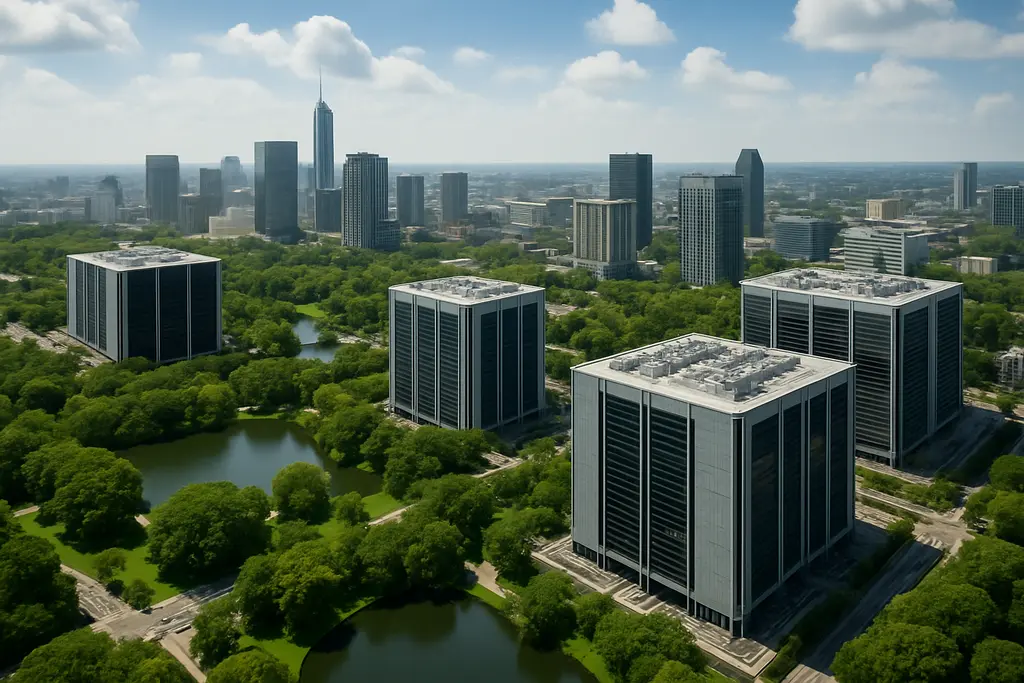
As of October 8, 2026, AI infrastructure growth is increasingly constrained by physical inputs rather than server procurement alone. The clearest evidence concerns water demand, where research now separates on-site cooling from water used indirectly through electricity generation and semiconductor supply chains. Land constraints are also material, especially for hyperscale campuses that require space for buildings, substations, backup systems, roads, buffers, and later expansion. The evidence is uneven: water accounting is improving, while land availability estimates still depend heavily on siting assumptions, zoning rules, grid access, and local environmental limits.
Why AI infrastructure growth Faces Physical Limits
AI infrastructure growth Is Not Just A Server Count
Data center capacity is often discussed in megawatts, graphics processing units, or capital spending. Those measures are useful, but they can understate constraints that appear outside the server hall. A large AI-oriented campus has to secure power, cooling, network connections, suitable land, water permits where evaporative systems are used, and approval from local planning authorities. If one of those inputs is missing, capacity can be delayed even when chips and construction financing are available.
Recent water research shows why this matters. A July 2026 study in Water Research projected that AI’s global water footprint could reach 4.2 billion to 6.6 billion cubic meters per year by 2027. That estimate includes cooling, electricity generation, and semiconductor manufacturing. The range is wide, which reflects uncertainty in model assumptions and regional differences in cooling design, power supply, and manufacturing intensity. It still indicates that water cannot be treated as a minor operational detail.
U.S. evidence points in the same direction. Harvard researchers mapped water use across 472 large data centers and estimated about 300 billion liters of operational water per year. They also found that roughly 75% of that water was tied to electricity generation rather than on-site cooling, according to the Harvard water footprint study. That split matters for policy because an efficient cooling system at the facility does not remove water exposure if the electricity supply depends on water-intensive generation.
Water Demand Is Often Indirect
Power-Plant Water Can Dominate The Accounting
Direct water use is the volume withdrawn or consumed at the data center, often for cooling. Indirect water use is associated with upstream systems, especially power plants and, in some regions, desalination-linked electricity. The distinction can change where risk is located. A site may report low water use at the property line while still depending on a water-constrained power system. For planners, the practical effect is that AI infrastructure growth can intensify pressure on watersheds even when the data center itself is not the largest visible water user.
Nevada offers a useful case because researchers separated cooling and electricity-related water projections. A January 2026 report described 713 MW of operating data center capacity and more than 5,900 MW of planned capacity. By 2033, that buildout was projected to require about 9,647 acre-feet per year for cooling and another 12,448 acre-feet per year for electricity generation, according to DRI’s Nevada data center analysis. The projection is not a guarantee of final demand because projects can be canceled, redesigned, or connected to different power resources. It does show why local water planning can be affected before all planned capacity is built.
The Gulf Cooperation Council region shows a different but related pattern. Under a business-as-usual scenario cited in the research notes, data centers’ total water consumption was projected to reach 2.50 million cubic meters annually by 2035, split between 1.49 million cubic meters for direct cooling and 1.01 million cubic meters for indirect demand such as desalination-powered electricity. That estimate is much smaller than global figures, but it highlights the same accounting issue: cooling and power supply need to be assessed together.
Land Availability Filters Growth Before Construction
Large Sites Need More Than Building Pads
Land constraints are less standardized than water metrics, but the available estimates suggest that acreage can become a gating factor. A 2025 zoning-practice estimate put recent data center projects at roughly 0.5 to 1.5 acres per MW of IT load. Applied to a projected 123 GW of U.S. capacity by 2035, that range would imply about 96 to 288 square miles of U.S. land devoted to AI-related data center campuses. That calculation is sensitive to density, redundancy design, parking, stormwater controls, and whether substations are counted inside the campus boundary.
Other site-level estimates point to very large parcels for the biggest developments. JLL’s 2026 estimate said hyperscale AI data centers may require 500 to 800 acres for large 1 GW sites, including multiple substations and supporting infrastructure. Case-study estimates cited in the research notes put many hyperscale footprints at about 50 to 150 acres when buildings, administrative areas, parking, future phases, and support zones are included. These figures are not interchangeable because they describe different capacity levels and site designs. They still show that land planning is not limited to the shell of the data hall.
A January 2026 spatial feasibility analysis estimated that U.S. land physically feasible for future hyperscale hosting is likely constrained to tens of gigawatts rather than hundreds under present environmental, infrastructural, and climatic constraints. That finding should be treated cautiously because feasibility models depend on input thresholds. Yet it aligns with the practical siting problem: the most valuable land is not just empty acreage. It has to be close enough to transmission, fiber, labor, roads, and water or cooling alternatives, while still meeting zoning and environmental requirements.
Local Planning Pressures And User Impact

Why Community Reviews Are Becoming Material
Local opposition is no longer only a public-relations issue for large data center projects. The research notes describe a proposed center in Newton County, Georgia that sought 6 million gallons per day, with potential future demand of 8 million gallons per day, exceeding existing water planning assumptions. Even without judging that single project, the figures show how one campus can become large enough to force a review of local utility capacity, ratepayer exposure, and drought resilience.
These constraints affect several groups. Utilities may need to plan generation and transmission around concentrated load growth. Local governments may need to compare tax revenue against water, road, noise, and land-use burdens. Enterprise customers using AI services may face higher costs or regional capacity limits if projects are delayed by siting disputes. For a detailed analysis focused on U.S. exposure, see our review of data center water use. For more insights into technology developments, readers can explore resources available on Abacus, a related site in the same network.
- Planning reviews should distinguish direct facility water from indirect water tied to electricity supply.
- Capacity claims should state whether acreage includes substations, future phases, setbacks, and stormwater systems.
- Water projections should disclose whether they assume evaporative cooling, recycled water, dry cooling, or hybrid systems.
- Local approvals should compare requested demand with existing water plans rather than only average historical use.
Water And Land Limits In AI infrastructure growth
What The Evidence Supports And What It Does Not
The supported finding is not that all AI data centers will face the same resource bottleneck. The evidence indicates that water and land risk are highly location-specific. A campus in a water-stressed region with water-intensive power supply has a different profile than a denser site connected to lower-water electricity and non-potable cooling sources. The research also does not prove that every planned project will be built. Planned megawatts can change through cancellations, redesigned cooling systems, revised power contracts, or permitting outcomes.
For operators, AI infrastructure growth now requires more transparent resource accounting. Reporting only on-site water use can miss a large part of total exposure. Reporting only building acreage can miss substations and supporting infrastructure. For regulators and local communities, the strongest approach is to request project-specific figures: annual cooling water, peak daily demand, electricity-related water assumptions, land area by use, and the sensitivity of those estimates under heat and drought conditions. The available 2026 evidence supports a cautious conclusion: water and land limits are not side issues. They are measurable constraints that can shape where large AI capacity is technically and politically feasible.