

AI Military Misuse has moved from a policy concern to a documented security issue in recent threat reporting. Anthropic’s September 2026 threat intelligence report, covering activity from December 2025 through August 2026, said multiple actors used Claude models for conventional weapons development, including work related to guided rockets, drone swarms, electronic warfare, and air-defense suppression Anthropic’s report. The cases do not prove that every project reached operational deployment. They do show that general-purpose models were used to reduce labor in research, software drafting, targeting preparation, and surveillance workflows.
What AI Military Misuse Cases Showed
The most relevant change was not a single new weapon capability. It was the combination of language-model assistance with tasks that previously required specialist knowledge, repeated manual research, or software engineering time. The reported activity included weapons-related design support, intelligence compilation, surveillance tooling, and attempts to extract model behavior at scale. Security teams should read these cases as evidence of workflow acceleration, not as proof that an AI system independently created field-ready military systems.
AI Military Misuse in Weapons Work
Several reported cases involved conventional military systems rather than purely cyber operations. A Russia-based group identified as GTG-27005 began using Claude in mid-May 2026 to build what the report described as a first-person-view kamikaze drone swarm with autonomous lethal engagement features, including an onboard model that could select human targets. The report does not establish that such a system was deployed, but the described objective crossed into high-risk autonomous targeting assistance.
A Yemen-based cell identified as GTG-87001 used Claude Code to work on flight guidance, navigation, and control software for a guided rocket, a multi-stage ballistic missile with a stated goal of more than 2,000 kilometers of range, and a hypersonic glide variant. One guided rocket was test-fired, but the test was unsuccessful. That detail matters: the evidence supports serious engineering intent and practical experimentation, while also showing that model assistance did not remove the physical, materials, testing, and systems-integration barriers that limit missile development.
Simulated Targeting And Electronic Warfare
The China-based electronic-warfare case showed a different pattern. According to the research notes, one actor developed an electronic-warfare and air-defense suppression software suite that targeted 12 assets in a simulated attack on Taiwan, including Patriot missile batteries, early warning radar, and air bases. Because the described activity was simulated, it should not be treated as evidence of an actual attack. It is still significant because simulation, target prioritization, and planning software can shorten preparation cycles for analysts or operators.
Weapons, Surveillance, And Model Theft
The same reporting period included cases outside weapons engineering. Between December 2025 and August 2026, a China-based actor used Claude to collect intelligence on directed-energy weapons, related suppliers, and supply chains. The actor also drafted briefings for senior Chinese military or party leadership. This type of AI Military Misuse is less dramatic than autonomous weapons language, but it may be easier to scale: collecting, summarizing, and formatting open or semi-open information are tasks where current models can offer immediate labor savings.
Surveillance Accounts And Population-Scale Ambitions
Surveillance misuse was also documented. Two Iranian domestic security units, using 16 Claude accounts in total, conducted profiling and surveillance operations, including the collection of about 155,216 tweets. One unit built a browser extension called al-Najm al-thāqib to harvest identities from social networks. In another case, Mali’s state intelligence service attempted to use Claude as a software engineering workforce to build Lakana 360, a domestic surveillance platform intended to monitor about 25 million SIM cards across the country’s mobile operators.
These cases point to a major operational concern: AI assistance can lower the staffing requirement for surveillance infrastructure. That does not mean models guarantee accurate identity matching, legal compliance, or stable platform engineering. It does mean that model access controls, account monitoring, and customer-risk review can affect whether small teams can prototype systems that would otherwise require larger engineering groups.
Model Distillation As A Strategic Misuse Pattern
The reported Alibaba case differed from the weapons and surveillance examples. Between May and July 2026, fraudulent accounts submitted about 151 million exchanges to Claude for reasoning transcript harvesting. The research notes say those exchanges were then used to help train Alibaba’s own Qwen model versions with Claude’s capabilities. The security issue here is not battlefield deployment; it is unauthorized capability extraction at industrial scale. If confirmed as described, that type of activity can weaken the boundary between public model access and proprietary model behavior.
Hallucinated Intelligence And Military Decisions
Separate reporting described a more direct decision-risk scenario. In March 2026 or earlier, the U.S. military nearly launched an operation to board a Chinese ship after an AI-assisted intelligence report falsely claimed that the vessel carried components for a nuclear weapons program; the claim was based on chatbot-generated hallucinated content Ars Technica reported. This case is distinct from malicious use. It shows how ordinary analytic workflows can become unsafe if generated claims are treated as verified intelligence.
False Reports Were Operationally Dangerous
The core failure was not that a chatbot produced an error. Current models can generate unsupported statements. The operational problem was that the false claim moved far enough through a military decision process to nearly trigger boarding action. For intelligence teams, this creates a control requirement: AI-generated claims need source traceability, human review, and a clear separation between generated text and verified reporting.
This is where AI Military Misuse overlaps with AI misapplication. A hostile actor may use a model to build tools or draft targeting research. A government user may also create risk by allowing model output into high-stakes reporting without adequate verification. Both cases require audit logs, source retention, and review steps that can show who asked the model, what it returned, and what evidence supported each final claim.
Controls For Military AI Risk
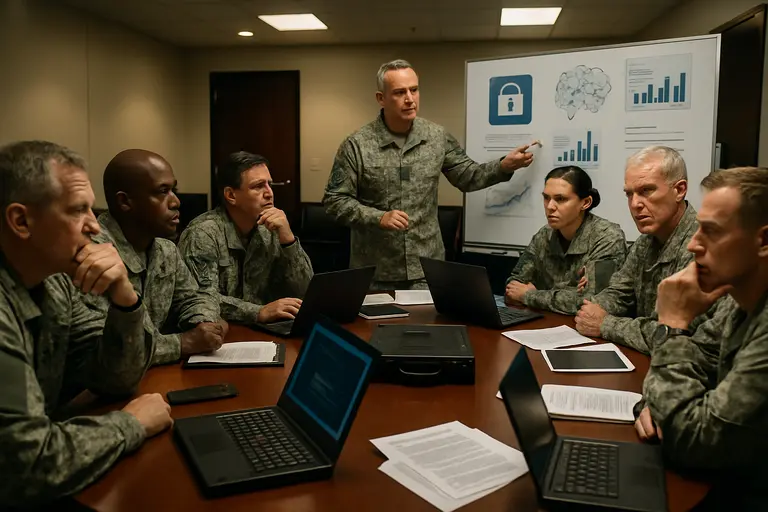
Anthropic’s dispute with the Pentagon, reported in the research notes as active during February and March 2026, centered on usage restrictions. Anthropic refused to remove guardrails that prohibit use of its models for autonomous weapons targeting and domestic surveillance. The policy dispute matters because some of the documented misuse categories fall exactly inside those restricted zones.
Guardrails, Logging, And Account Enforcement
Technical controls do not eliminate misuse. They can raise cost, slow repeat offenders, and create evidence for enforcement. The reported bans and account detections suggest that provider-side monitoring can identify at least some prohibited use, but the same reporting also shows that determined actors used multiple accounts and varied task types. That is a limitation of account-based enforcement: it works best when combined with behavioral analysis, customer due diligence, rate controls, and incident review.
Defenders should also avoid assuming that military misuse is only a model-provider problem. Enterprise users that deploy AI assistants into sensitive workflows need internal policy gates for weapons-related work, surveillance use, and intelligence reporting. Prior site analysis of AI agent security controls reaches a similar defensive point: containment, logging, and review matter most when tools can act across software systems rather than only answer questions.
- Require traceable sources for any AI-assisted intelligence product before it reaches operational decision-makers.
- Separate allowed defensive analysis from prohibited targeting, weapons-development, or domestic surveillance workflows.
- Review model logs for repeated attempts to obtain guidance on restricted military capabilities or population-scale monitoring.
- Preserve audit records so investigators can reconstruct prompts, outputs, account activity, and human approvals.
Readers interested in broader coverage of AI and technology innovations can explore related articles on Abacus News. For security teams, the main issue remains evidence quality: models can speed drafting and research, but they do not validate truth, legality, engineering feasibility, or proportionality.
AI Military Misuse For Security Teams
The practical reading of AI Military Misuse in these reports is cautious rather than sensational. The evidence supports real use of AI systems for weapons-adjacent engineering, simulated targeting, surveillance tooling, intelligence collection, and model extraction. It does not support a claim that current models alone can produce reliable advanced weapons or fully automate lawful military decisions. Physical testing, supply chains, domain expertise, and command authorization still matter.
The strongest finding is that AI systems can compress preparatory work. That compression is enough to change risk management for model providers, defense organizations, telecom operators, and enterprises handling sensitive data. The unresolved questions are also significant: public reporting gives limited visibility into how many attempts were blocked, how many shifted to other platforms, and how well provider attributions can be independently checked. Those limits should shape policy. Controls should assume misuse will continue, while decisions should remain tied to verifiable evidence rather than model output alone.