
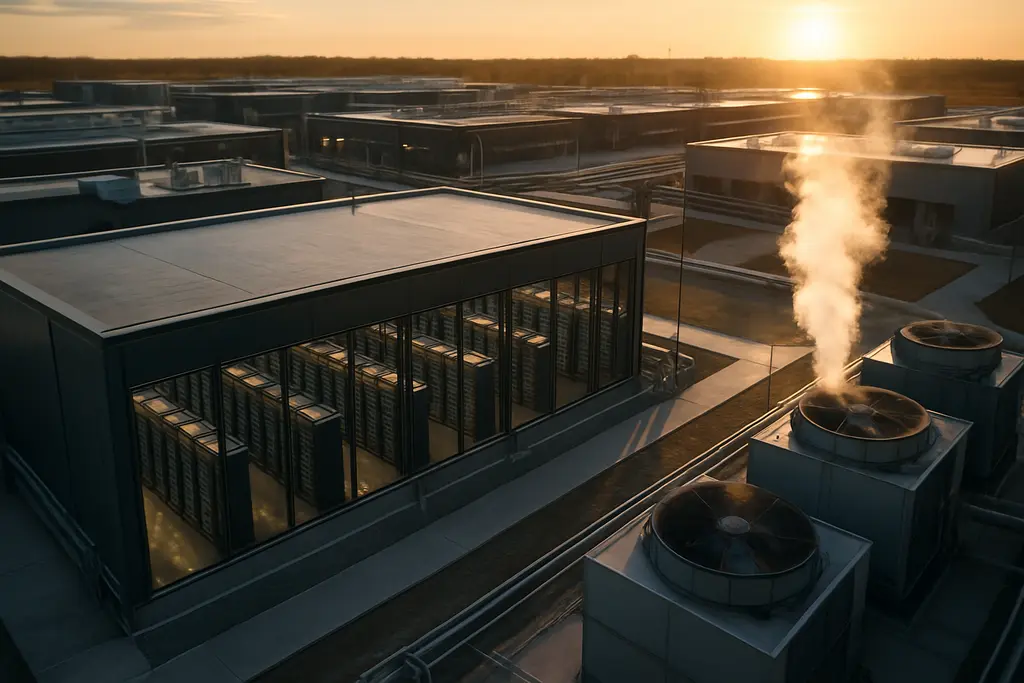
AI data centers now sit at the center of a measurable environmental problem: demand for high-density computing is rising faster than many grids, cooling systems, and reporting practices were designed to handle. The issue is not only the electricity used to train large models. Research cited in 2026 points to a wider footprint across power generation, water withdrawals, land occupancy, hardware replacement, and local infrastructure strain. The available data supports concern, but it also has limits because facility-level disclosure remains uneven and projections depend on workload growth, grid mix, cooling design, and efficiency gains.
Why AI data centers Have A Larger Footprint
AI data centers Power Demand In 2026
The most direct environmental pressure is electricity use. Gartner projected that global data-center electricity consumption would grow 26% in 2026, reaching 565 terawatt-hours, compared with 447 TWh in 2025. The same forecast said AI-optimized servers would account for 31% of data-center power consumption in 2026 and consume more electricity than conventional servers by 2027, according to Gartner. That scale matters because data centers are not spread evenly across power systems. They are often built in clusters where fiber access, land, tax policy, and interconnection options make large campuses economical.
The technical driver is straightforward: AI accelerators can draw large amounts of power, and dense racks require more supporting infrastructure. Servers are only part of the total load. Power distribution equipment, backup systems, networking gear, and cooling also consume energy. In common data-center accounting, the difference between IT load and total facility load is captured by power usage effectiveness, but that metric does not show whether the electricity comes from coal, gas, nuclear, hydro, wind, or solar. A low facility overhead can still be paired with a high-carbon grid.
For AI data centers, utilization patterns matter as much as hardware type. Training runs receive attention because they are large, visible compute events. Daily inference can become more significant at scale because millions of small requests may repeat continuously. Response length, image or video resolution, retrieval settings, and model-routing choices can all change compute demand. The research base supports the direction of this effect, but public data rarely shows enough detail to compare specific services on equal terms.
Cooling, Water, And Land Pressures
Electricity is not the only constraint. Cooling design connects AI infrastructure to water use, land needs, and emissions trade-offs. The United Nations University Institute for Water, Environment and Health reported that by 2030 the water footprint for AI-powered data centers could reach 9.3 trillion liters per year, while the land footprint for related infrastructure could exceed 14,500 square kilometers; the same analysis also discussed an annual AI-infrastructure e-waste challenge of about 2.5 million tonnes by 2030, according to UNU-INWEH. These are projections, not measured 2030 outcomes, but they show why the footprint cannot be assessed through electricity alone.
Water use depends heavily on the cooling system and climate. Evaporative cooling can lower electricity demand in some conditions but consumes water. Dry cooling can reduce water use but may require more electricity, especially during hot periods. Liquid and immersion cooling can improve heat transfer at the rack level, yet they do not remove the need to reject heat somewhere. Each approach moves the burden between water, power, cost, maintenance, and site suitability.
Land use is also broader than the building footprint. A large AI campus may require substations, transmission upgrades, backup generation, construction staging, water systems, and network connectivity. That land impact is not always visible in corporate sustainability summaries. For those interested in diving deeper into these infrastructure topics, Camp Tech Wise offers technical explainers that provide essential background knowledge, though facility-specific environmental data remains the key evidence base.
What The Current Evidence Shows And Does Not Show
Measured Loads Versus Forecast Scenarios
The strongest numbers available in the research are system-level electricity estimates and near-term demand forecasts. They are useful because they show direction and scale. They are less useful for assigning responsibility to a single model, vendor, or product feature. Many public estimates blend cloud computing, enterprise workloads, content delivery, storage, crypto-related loads where relevant, and AI workloads. Separating those categories depends on assumptions that may not be disclosed.
This creates a risk of both undercounting and overclaiming. Underreporting can happen when companies disclose market-based renewable energy purchases but not hourly matching, local grid impact, or water stress at the facility site. Overclaiming can happen when a global projection is treated as proof that every AI deployment has the same impact. The more defensible approach is to separate confirmed demand growth from the less certain allocation of that demand across workloads.
Embodied emissions add another measurement gap. Large accelerator clusters require chips, memory, circuit boards, racks, power equipment, cooling hardware, concrete, steel, and frequent maintenance. Some research cited in the user-provided notes states that embodied emissions can represent more than half of lifetime emissions for large AI facilities. That figure is plausible in direction for hardware-heavy installations, but it depends on equipment lifetime, utilization, manufacturing energy mix, and whether a campus expands in phases. Public reporting rarely gives enough detail to verify the number facility by facility.
Regional Grid Stress And Cost Exposure
AI data centers can affect regions differently. A 100-megawatt load added in an area with spare transmission capacity and low-carbon generation is not the same as the same load added in a constrained grid zone. In dense clusters, utilities may need new substations, transformers, switchgear, transmission lines, or generation resources. Those assets take time to permit and build. The research notes point to capacity constraints for transformers, power electronics, and cooling systems around 2027 in some markets, which means equipment availability may shape project timing as much as software demand.
Cost allocation is a policy issue as well as an engineering issue. If grid upgrades are built to serve large campuses, regulators must decide which costs are paid by the data-center operator and which are spread across ratepayers. This is one reason facility-level transparency matters. Without clear data on load size, ramp schedule, backup generation, water use, and contracted power supply, local communities cannot easily evaluate trade-offs. A related analysis of AI infrastructure and grid limits covers the same siting and power-planning problem from a grid perspective.
Mitigation Options With Practical Limits

Efficiency Helps But Does Not Set A Cap
Efficiency gains are necessary, but the evidence does not support treating them as a complete answer. More efficient chips, better power supplies, improved cooling controls, and workload scheduling can reduce energy per task. Yet total energy can still rise if the number of tasks grows faster than efficiency improves. This rebound risk is especially relevant for consumer-facing AI systems where longer outputs, higher media resolution, or automatic background processing can multiply demand.
Demand-side controls are therefore part of environmental design. Shorter default responses, lower-resolution outputs where adequate, caching, model selection based on task difficulty, and scheduling non-urgent jobs during periods of cleaner electricity can reduce avoidable load. These measures do not require users to understand the power system, but they require product teams to treat compute as a managed resource rather than a negligible cost.
Transparency, Siting, And Maintenance
Better disclosure would make environmental claims easier to verify. Useful reporting would include facility-level electricity use, hourly or regional power sourcing, water consumption, water stress context, land occupancy, hardware replacement cycles, and e-waste handling. Annual corporate totals can hide local impacts because a water-efficient site in one region does not offset water stress near another site in a simple physical sense.
Siting decisions also need caution. Cold regions can reduce cooling energy, but they still need transmission access, construction materials, backup systems, and network capacity. Renewable power contracts can lower emissions on paper, but the environmental value depends on whether new clean generation is added, when it produces electricity, and whether it matches facility demand. Dry cooling can conserve water, yet increase power demand. These trade-offs mean no single design choice removes the footprint.
Maintenance and hardware turnover deserve more attention. If accelerators are replaced quickly, embodied emissions and e-waste rise. Reuse, repair, component recovery, and longer service lives can reduce material pressure, but they may conflict with performance demands and energy efficiency improvements. The best option depends on whether newer hardware saves enough operational energy to justify the manufacturing footprint of replacement equipment. Public data is still too limited to apply one answer across all facilities.
AI data centers Environmental Footprint Decisions
The evidence available by September 28, 2026 supports a cautious reading: AI data centers are increasing environmental pressure, especially through electricity demand, cooling needs, and hardware turnover, but the exact impact varies by site, grid, workload, and reporting quality. The most defensible policy and engineering response is not to stop at broad global totals. Decision-makers need facility-level data, workload-aware efficiency targets, and local grid and water analysis before approving or expanding large campuses.
The main uncertainty is not whether AI infrastructure uses real resources; the evidence shows that it does. The uncertainty lies in how fast demand will grow, how much efficiency will offset that growth, and whether operators will disclose enough data for public verification. Practical controls already exist: cleaner power matching, careful siting, cooling choices suited to local water stress, hardware life-cycle planning, and product defaults that limit unnecessary compute. Their effectiveness will depend on adoption, measurement, and whether growth in usage outpaces the savings.