
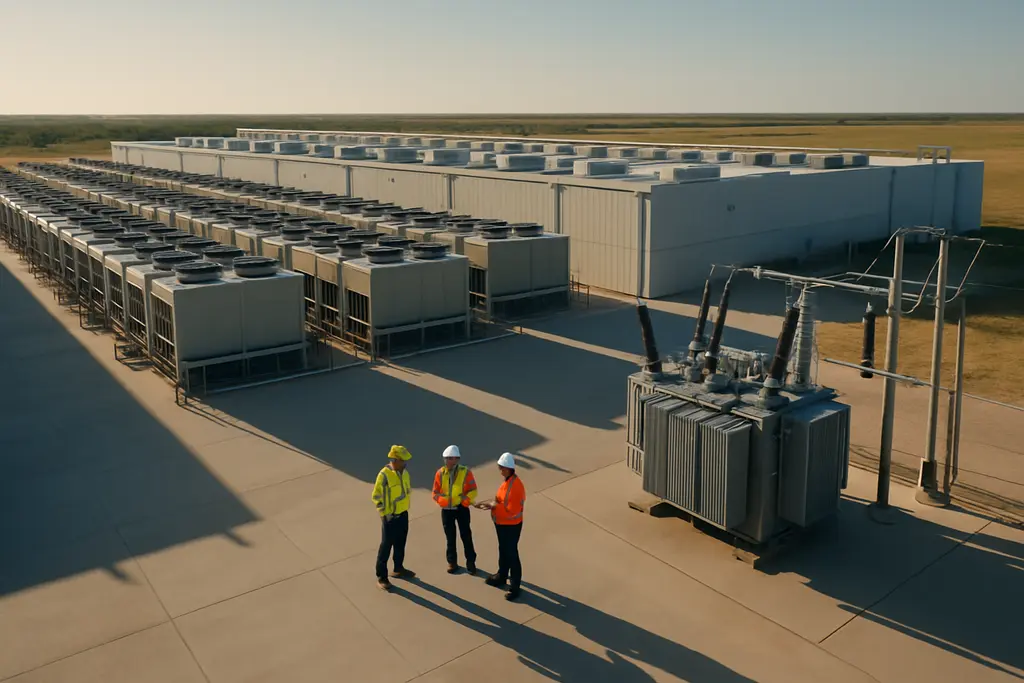
Texas Data Centers have shifted from a site-selection story to a power-access story. As of September 28, 2026, the supported evidence points to three main constraints: very large requested loads, revised grid connection rules, and uncertainty over long-term supply. The available data does not show that expansion has stopped. It shows that electricity access has become harder to schedule, price, and approve.
Why Texas Data Centers Face Power Limits
Texas Data Centers And Load Applications
The scale of requested load is the first barrier. Research notes for this guide cite about 410 gigawatts of load applications under ERCOT management, nearly five times the grid capacity referenced for early 2026, with roughly 90% tied to data center requests. A second queue estimate cited in the same research puts requested large-load capacity near 474 gigawatts, again with almost 90% from data centers. These figures differ, but both point in the same direction: the requested load is far larger than what the existing system can absorb without careful staging and grid work.
For Texas Data Centers, the queue itself has become a screening mechanism. A project can have land, capital, and equipment plans, yet still face an uncertain energization date if the local transmission system cannot support the proposed load. That matters because data center economics depend on staged buildouts, predictable commissioning dates, and stable power contracts.
Large Flexible Load Demand
The demand growth is not theoretical. The U.S. Energy Information Administration reported that large flexible load customers, including data centers and cryptocurrency mining operations, were projected to consume 54 billion kilowatt-hours in 2025, equal to about 10% of total ERCOT grid electricity and nearly 60% above expected 2024 demand EIA data. That scale changes planning assumptions for utilities, transmission owners, and large customers.
Large flexible loads can sometimes reduce consumption during grid stress, but that flexibility is not the same as firm capacity. A high-performance computing campus may have service-level obligations, cooling constraints, and customer contracts that limit how often it can curtail. The research supports caution here: flexibility can help grid operators, but it does not remove the need for generation, transmission, protection equipment, and voltage stability.
Interconnection Rules And Reliability Tests
Batch-Based Reviews
Texas passed Senate Bill 6 in 2025 to manage large power users. Under the framework described in the research, projects drawing 75 megawatts or more moved into a batch-based interconnection process. The purpose is to review large requests as a group instead of processing them one at a time. That approach can give ERCOT and regulators a clearer view of how multiple large loads affect the same transmission zones.
The “Batch Zero” framework, approved on June 18, 2026, applies this grouped study method to large-user requests of at least 75 megawatts. The practical result is that developers face a more formal review path. That may slow some individual projects, but the reason is technical rather than administrative alone: one project’s load can change the feasibility of nearby projects if they rely on the same substations or transmission corridors.
Voltage And Physical Grid Limits
The research also notes that some large data centers and crypto facilities failed reliability or voltage tests while seeking connection ahead of peak summer demand. That finding is significant because voltage performance is a physical constraint, not a paperwork issue. If a large facility causes voltage instability, operators may need new equipment, local reinforcement, operating limits, or delayed energization.
This is where expansion plans become less predictable. A hyperscale or AI-focused site may publish a target opening date, but energization depends on grid studies, equipment availability, and operating conditions. A pass/fail test outcome can affect when servers are installed, when cooling systems are commissioned, and when customer workloads can move in.
Supply, Transmission, And On-Site Power
Forecast Deficits Through 2035
Longer-term supply is the second major constraint. A University of Houston grid study cited in the research estimates that even projects approved to energize could contribute to a statewide supply deficit starting around 2031, with an expected gap of 17 to 40 gigawatts by 2035 depending on the growth scenario University of Houston study. The range is wide, which signals uncertainty, but even the lower end is large enough to affect planning.
The limitation is that forecasts depend on assumptions about project completion, load behavior, new generation, storage deployment, transmission upgrades, and demand response. A forecast is not a measured shortage. It is a warning that approved and proposed loads may exceed the pace of supply additions under some conditions.
Renewables, Storage, And Hybrid Systems
The research notes that wind and solar supplied about 35% of ERCOT electricity in 2024. That is a meaningful contribution, but intermittent production and transmission bottlenecks limit how quickly renewables can offset large new loads. Data centers need stable power across hours when wind and solar output can vary, so storage, transmission, and dispatchable resources still matter.
On-site generation, behind-the-meter power, hybrid supply models, and microgrids are appearing more often as ways to reduce grid reliability risk. These options do not erase the barrier. They can raise capital costs, require fuel logistics or emissions review, and add permitting steps. They can also complicate operations because a data center operator then manages part of the energy system rather than relying only on grid supply.
Operational Costs And Community Constraints

Costs That Move Beyond Electricity
Power constraints affect more than utility bills. Delayed interconnection can leave expensive buildings, cooling systems, and server procurement plans out of sync. If a facility must add on-site generation or more backup capacity, the cost profile changes again. Related analysis of data center electricity and cyber cost risk explains why energy planning now affects operating budgets as well as resilience programs.
Operators comparing field infrastructure, power gear, and ruggedized technology tradeoffs may find detailed hardware insights at Camp Techwise. Facilities often need more focus on equipment maintenance and backup systems when they cannot depend on a straightforward utility-service timeline, making practical guidance essential.
Local Permitting And Siting Friction
The research identifies permitting delays and local opposition as non-technical barriers. Concerns include noise, water use, pollution, traffic, zoning uncertainty, and local regulatory review. These issues vary by site, so they should not be treated as uniform across Texas. Still, they can affect schedules even when a developer has a power strategy.
Community concerns can also interact with energy choices. A site that adds on-site generation may face more scrutiny than a site relying mainly on grid power. A campus using water-intensive cooling may face different questions than one using another cooling design. The supported evidence does not provide a single statewide permitting delay figure, so the safest reading is that siting risk is project-specific but rising in visibility.
Texas Data Centers Power Barrier Checklist
What Is Supported By The Evidence
The strongest evidence supports a measured view. Power demand from large flexible loads is rising quickly. ERCOT-facing connection requests are very large. Texas has changed its interconnection process for large users. Forecasts show possible supply gaps after 2031 under some growth scenarios. Local permitting and community concerns can slow projects, but the severity varies by location.
- Verify whether a proposed site is affected by the 75 megawatt large-load review threshold.
- Model energization timing separately from construction timing.
- Test whether curtailment promises are realistic for the workloads planned at the site.
- Account for transmission upgrades, storage, or on-site generation as cost variables.
- Assess water, noise, emissions, and traffic concerns before treating land control as site readiness.
How Texas Data Centers Can Read The Risk
The evidence points to a planning constraint, not a ban on growth. Some projects may move forward if they have favorable locations, credible power arrangements, and clear permitting paths. Others may face delays if they depend on constrained transmission areas or if their load size triggers extended review. The central issue is that grid access has become a gating factor equal to land, fiber, tax treatment, and construction capacity.
The limits of the findings should be clear. The research combines measured demand, queue estimates, policy changes, and forecasts. Queue size does not equal final built load, because some projects will be delayed, resized, relocated, or withdrawn. Forecasted shortages are scenario-based. Even so, the direction of the evidence is consistent: power availability is now one of the main barriers to large data center expansion in Texas.